

















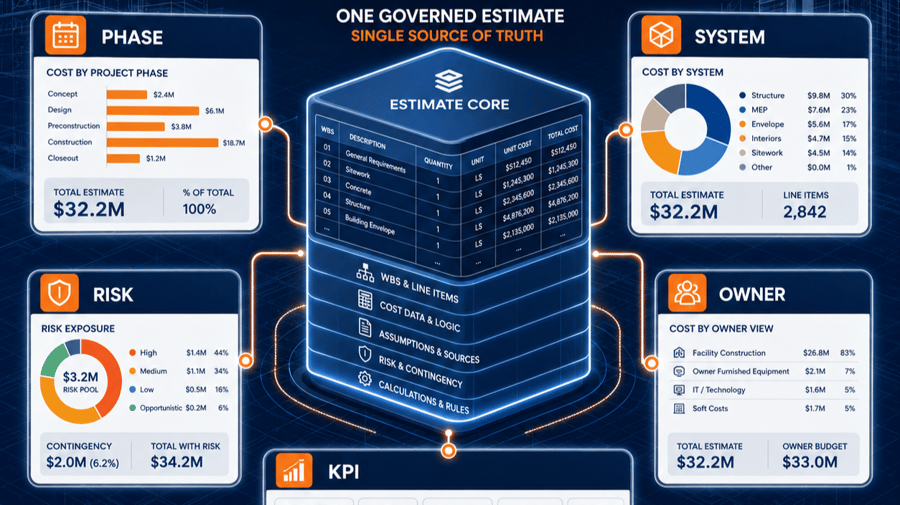
What You Need to Know: The most effective preconstruction teams don't choose between consistency and flexibility; they design their estimating discipline to support both. When an estimate carries unlimited WBS properties and KPIs, it becomes a multidimensional dataset that can be viewed by phase, system, risk, or owner lens without rebuilding from scratch. Company-defined standards create the foundation. Project-specific attributes enrich it. The result is an estimate that satisfies any question without compromising the integrity of the data behind it.
The Question Every Project Eventually Asks
Every project eventually asks the same question: Can you show the estimate differently?
Different owner breakdowns. Different internal KPIs. Different ways to explain cost, scope, and tradeoffs to audiences who think about projects in completely different terms. An owner wants cost by building system. Finance wants cost by phase. The design team wants to understand cost by scope category. Leadership wants to see cost per key metric - dollars per square foot, cost per bed, cost per parking space.
Too often, answering those questions means reworking the estimate, exporting data, or bending standards just to satisfy the moment. An estimator rebuilds the estimate structure for the owner presentation. Another version gets created for the internal review. A third gets exported to a spreadsheet for the executive dashboard. Each version drifts slightly from the others. Each requires maintenance. Each introduces the possibility of inconsistency.
That's where many preconstruction teams get trapped - between consistency and flexibility. The consistent approach preserves data integrity but can't easily respond to different reporting demands. The flexible approach satisfies the moment but fragments the underlying data. Teams feel forced to choose, and either choice costs something.
But that tradeoff is a design problem, not an inherent limitation of estimating.
The Estimate as a Multidimensional Dataset
The real power isn't just in building an estimate. It's in how easily that estimate can be sliced, grouped, filtered, and interrogated without breaking the underlying structure.
When an estimate carries an unlimited set of WBS properties and KPIs, it stops being a static worksheet and becomes a multidimensional dataset. Every line item, takeoff, and bid holds more context: scope classifications, system types, owner-required breakdowns, internal KPIs, project-specific attributes, and risk designations. With that depth comes the ability to view the same estimate in endlessly different ways - by phase, by system, by risk, by owner lens - without rebuilding it from scratch.
This distinction matters more than it appears. A static estimate answers the question it was built to answer. A multidimensional estimate answers questions that weren't anticipated when it was built. The owner changes their reporting requirements mid-project. A new stakeholder joins and needs a different view. Leadership wants to benchmark this project against a specific subset of historical work. A multidimensional estimate handles all of these without requiring a new estimate - or a new version of an existing one.
The practical implication: estimators spend less time reformatting and more time analyzing. The data serves multiple audiences simultaneously rather than requiring separate preparation for each. And the underlying structure remains intact regardless of how the data gets presented - because the presentation is a view of the estimate, not a modification to it.
DESTINI Estimator is built around this principle. Properties applied to estimate elements create the depth that makes multidimensional analysis possible. The same estimate can render as a CSI breakdown for the design team, a phase breakdown for the schedule, a system breakdown for the owner, and a risk-weighted view for internal leadership - all from one governed data structure without duplication or reformatting.
See how DESTINI Estimator supports multidimensional estimates →
Standards Are the Foundation, Not the Constraint
The foundation still matters. Company-defined standards create consistent workflows across teams, reliable historical data, and confidence that numbers mean the same thing from project to project. Those standards are what make analytics, benchmarking, and long-term insights possible.
Without standards, flexibility becomes chaos. If every estimator structures work differently, every project becomes its own isolated dataset. Comparison across projects isn't possible because the underlying definitions don't align. Historical benchmarking becomes meaningless because the items being compared aren't actually the same thing measured the same way. The flexibility that felt useful in the moment produces fragmented data that can't compound into organizational intelligence.
What separates high-performing preconstruction organizations is how they configure beyond those standards rather than overriding or removing them. They don't compromise their core structure when a project demands something different - they augment it. The standard remains intact. The additional layer answers the project-specific question without polluting the data that makes cross-project comparison possible.
This is a more sophisticated discipline than either rigid standardization or unconstrained flexibility. It requires deliberate design: deciding which elements are non-negotiable standards and which elements are project-specific attributes that can vary without undermining comparability. Getting this design right is what enables the estimate to be both consistent and responsive.
Enriching Standards Without Weakening Them
Never weaken your standards - enrich them.
Project-type templates add necessary layers for healthcare, mission-critical, or other specialized work that requires attributes standard estimates don't carry. A healthcare project might need infection control zone classifications, clinical adjacency requirements, and equipment package designations that a standard commercial project doesn't require. Those attributes add to the estimate without replacing the standard structure that enables comparison across the broader portfolio.
Owner-specific attributes apply at the project level to meet unique reporting requirements without becoming part of the standard library. An owner who requires cost breakdown by building zone, occupancy type, or funding source gets exactly that - through properties applied to the project without modifying the underlying definitions that govern every other estimate the firm produces.
Temporary data points allow teams to meet immediate project needs without polluting the historical record. A one-time analysis required for a specific value engineering session doesn't need to become a permanent attribute that clutters every future estimate. Temporary properties serve their purpose and disappear without leaving structural residue.
Each of these mechanisms preserves the integrity of what's underneath while extending the estimate's ability to answer the question in front of it. The answer doesn't require bending the system - it requires knowing how to layer additional context on top of a system that was designed to receive it.
KPIs That Explain Cost
This becomes especially valuable when project KPIs are intentionally defined and linked directly to the estimate. Cost history shifts from blunt averages to meaningful comparisons.
Dollars per gross square foot is useful as a starting point. But dollars per gross square foot for a specific building type, in a specific market, in a specific size range, built under a specific delivery method - that's genuinely useful. It's a comparison that accounts for the variables that actually drive cost rather than averaging across projects that shouldn't be averaged together.
The same principle applies across project types. Cost per parking space for structured parking. Cost per hotel key for hospitality. Cost per bed for healthcare. Cost per megawatt for data centers. Dollars per student station for education. These metrics frame cost in relation to the things that actually drive it - the program elements that owners make decisions about. When estimators can report cost in these terms, conversations with owners move from abstract line items to meaningful program economics.
Suddenly, teams are explaining cost in relation to the things that drive it. An owner considering adding 50 hotel keys to the program can immediately see the cost implication in terms they already understand. A healthcare system evaluating bed count can assess cost impact without translating from construction categories into clinical program terms.
This kind of communication requires more than good presentation skills. It requires an estimate structured with the properties that enable KPI calculation - and a system that performs those calculations dynamically as the estimate evolves. When the design changes, the KPI updates. When scope is added, the metric reflects it. The estimate and the insight stay synchronized because they share the same data source.
One System, No Second Model
Because all of this lives in the same system, there's no second model and no disconnected spreadsheet. Teams aren't interpreting the estimate after the fact - they're learning from it.
The alternative is familiar and costly. An estimate gets built in the estimating system. Someone exports it to Excel to create the owner's preferred view. Someone else builds a PowerBI dashboard that pulls from a different export. Leadership reviews a summary that was prepared from the dashboard. Each step removes the data further from its source. Each step introduces the possibility of error, lag, and inconsistency.
By the time the question gets answered, the answer might not reflect the current state of the estimate. The export happened before the last design revision. The dashboard hasn't updated since the bid came in. The summary was prepared from last week's numbers. The team is defending data that's already outdated.
A single governed system eliminates this chain. Every view - owner breakdown, internal KPI, risk view, executive summary - reflects the same current estimate. When the estimate changes, every view reflects the change. There's no reconciliation between versions because there's only one version.
This is the difference between slicing and exporting. Exporting creates a copy that immediately starts diverging from the source. Slicing creates a view that stays synchronized with it. Both look similar in the moment. The difference becomes visible over time - and in preconstruction, time always reveals the tradeoffs that were made.
Building Confidence That Outlasts the Project
At scale, this approach does more than satisfy individual projects. It creates a shared estimating discipline across the organization - one system of record, one consistent way of building estimates, and enough flexibility to meet the needs of any project, without sacrificing the integrity of the data.
The teams that get this right build confidence - in their numbers, in their history, and in their ability to explain decisions long after they were made. That confidence shows up in GMP negotiations when the estimate needs to be defended. It shows up in executive reviews when leadership asks how this project compares to similar work. It shows up in client conversations when owners want to understand what's driving cost and why.
It also shows up in how organizations grow. New estimators who join a firm with governed, enriched estimates onboard into a system that teaches them how the firm thinks about cost. They don't have to reverse-engineer conventions from individual projects or learn through trial and error what a line item includes. The structure itself conveys the discipline.
That organizational confidence compounds over time. Every project adds to the historical record in a form that's comparable, analyzable, and trustworthy. Every KPI calculated from a real project refines the benchmarks that inform the next estimate. Every standard maintained through a difficult project strengthens the reliability of the data that comes after it.
In preconstruction, that's what ultimately survives - not the dashboards, not the exports, not the one-time workarounds. The discipline embedded in how estimates are built, enriched, and maintained across the organization.
Build estimates that answer any question without losing their integrity:
See how DESTINI Estimator's multidimensional estimate structure supports unlimited WBS properties, owner-specific breakdowns, and project KPIs - all from one governed data source.
Learn More About DESTINI Estimator →
Explore how consistent standards and flexible enrichment work together to support any reporting requirement without compromising the integrity of your estimating data.