


















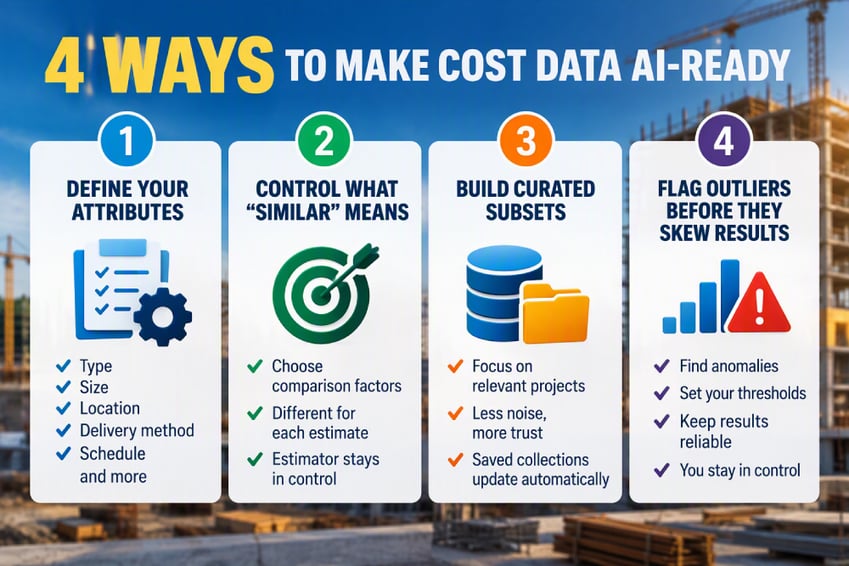
What You Need to Know: Many AI estimating tools work as a black box: data goes in, a number comes out, and no one can explain how it got there. For estimators, that is a dead end. A number you can't trace is a number you can't adjust, defend to an owner, or check for errors before it reaches a bid. A glass-box approach shows its work, from which historical projects were treated as comparable and which attributes drove the match to which records were set aside as outliers. That visibility keeps the estimator in control, makes real review possible, and earns the trust of experienced estimators who want to see every number going in.
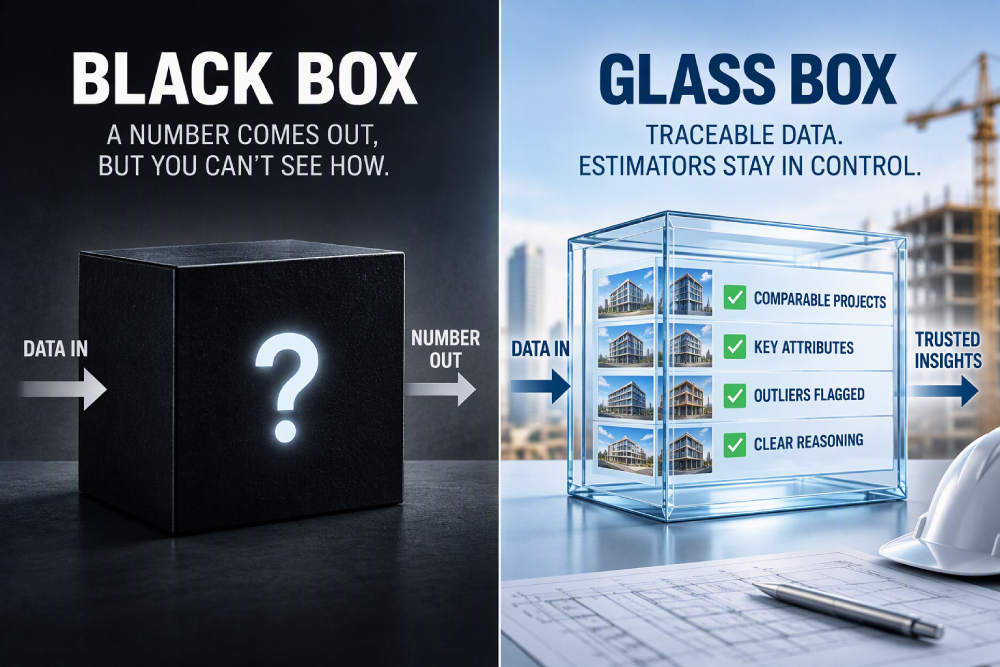
Black box vs. glass box
Every estimator has been asked some version of the same question: "Where did this number come from?" An owner wants to know why the budget moved. A project executive wants to know why your number is higher than the last job's. A superintendent wants to know whether you accounted for the site conditions.
A good estimator can answer, because they built the number and know every assumption behind it. But as AI takes on more of the research and pricing work, that answer gets harder to give. At Precon World 2026, transparency came up again and again as the dividing line between AI tools estimators will use and tools they'll quietly ignore.
The question isn't whether AI belongs in estimating. It's whether you can see what it's doing.
What a black box costs an estimator
A black-box tool takes in data and hands back an answer without showing the reasoning in between. That might be fine for a movie recommendation. In estimating, where a single number can decide whether a job makes or loses money, it creates four problems.
You can't adjust it. Estimating is judgment applied to data. If you don't know the basis of a number, you don't know where to start changing it. Was it driven by a project in a different market? An outdated escalation rate? A one-off job with unusual scope? Without that visibility, your options are to accept the number as is or throw it out.
You can't defend it. Owners, design teams, and leadership all expect estimators to explain their numbers. "The software said so" doesn't build client trust, and trust is one of the most valuable things preconstruction delivers.
You can't catch its mistakes. Every historical database has miscoded projects and outliers. A black box treats them as valid inputs and returns a result that looks just as confident as a good one. A wrong number that looks authoritative is harder to catch than a blank cell.
You can't learn from it. Junior estimators build expertise by understanding why numbers come out the way they do. A tool that hides its reasoning hands them answers without teaching them anything, which makes the talent gap worse, not better.
The result is a workflow many estimators know too well: copy the AI's number into a spreadsheet, then spend hours trying to reverse-engineer whether it can be trusted.
What a glass box approach looks like
A glass-box approach still uses AI to do the heavy lifting. The difference is that every prediction comes with its reasoning attached. In practice, that means:
- Traceable comparables. You can see exactly which historical projects informed a number, and open any of them to check the details.
- Visible similarity logic. You know why those projects were considered comparable. Better yet, you can choose a baseline project and decide which factors, such as date, size, or type, define "similar" for this estimate.
- Exposed attributes. The project data driving the match, from basic fields to complex ratios and formulas, is visible rather than buried in a model.
- Flagged outliers. Records that fall outside normal ranges are surfaced, not silently included or excluded, and you can set the thresholds yourself.
- Adjustable inputs. When you disagree with an assumption, you can change it and see how the number responds.
The estimator stays in control of the number. The AI handles the research; the estimator applies the judgment.
Transparency makes review possible
One of the liveliest debates at Precon World was about review. One side argued that AI finally gives preconstruction teams the bandwidth to review estimates properly, something they rarely had time for before. An estimator in the audience pushed back: AI-produced work that hasn't been reviewed carefully is obvious, and it's embarrassing in front of a client.
Both points can be true, and transparency is what connects them. You can only review what you can see. A black-box number leaves a reviewer two choices: rubber-stamp it or redo the work from scratch. A glass-box number lets a reviewer check the comparables, question the outliers, and test the assumptions in a fraction of the time.
Transparency also matters for adoption. Estimators who learned the trade by hand are often the most wary of automation, and for good reason. They've seen what happens when a bad number goes out the door. They don't need to be talked into trusting AI. They need to be able to verify it. A tool that shows its work gives veterans a way in, while still letting more tech-savvy estimators automate as much as they like.
Questions to ask before buying an AI-powered estimating tool
If you're evaluating construction estimating software with AI for your preconstruction team, these questions will quickly separate glass boxes from black boxes:
- Can it show me which projects informed this number? If the answer is no, or "the model considers your entire history," keep looking.
- Can I control what counts as a comparable project? You should be able to choose the baseline and the factors that define similarity.
- How does it handle outliers? Look for visible flags and adjustable thresholds, not silent filtering.
- Can I change an assumption and see the impact? A tool you can't adjust is a tool you'll end up working around.
- Can each user choose their level of automation? Your team includes people who want to see every input and people who want to automate everything. The tool should support both.
- Will I be locked in? If the only thing you can do with a number is paste it into a spreadsheet, the tool isn't really part of your workflow.
Run the evaluation on your own messy historical data, not a vendor's tidy sample set. That's where the difference between a black box and a glass box shows up.
Show your work
Estimators have always been expected to show their work. AI doesn't change that expectation. It raises the stakes. As more of the research and pricing moves to automated tools, the ability to see, question, and adjust every number becomes the thing that separates a faster estimate from a better one.
Choose tools that let your team see the math. Your estimators, your clients, and your margins will all be better for it.
Learn More About DESTINI Estimator →