

















What You Need to Know: Self-perform work - the scopes a general contractor builds with its own crews and equipment instead of subcontracting - puts the margin and the risk squarely on the contractor, which means the estimate can't be a subcontractor's fixed price; it has to be built from quantities, crews, equipment, and production rates. DESTINI Cloud Self Perform builds exactly that in one connected, cloud-native platform: takeoff quantities flow straight into self-perform line items, crews and rates are backed by your own historical cost data, and the result is an estimate that's faster to produce, easy to defend, and clear about where your margin truly sits.
When a contractor self-performs, the crew, the equipment, and the production risk all belong to them. That's the upside - and the reason a self-perform estimate can't be a number pasted in from a subcontractor. It has to be built.
What "self-perform" means
Most of a commercial project gets subcontracted out. But many general contractors keep certain scopes in-house - concrete, earthwork, structural steel erection, rough carpentry, site utilities - and run them with their own crews and equipment. That's self-perform work, and contractors do it for good reasons: better control of schedule and quality, protection against a thin subcontractor market, and margin they keep rather than pass along.
The trade-off is that the contractor now owns the risk. A subcontractor bid is a fixed promise; a self-perform scope is a forecast. If the crew mix is wrong, the production rate is optimistic, or the equipment hours are underestimated, that gap comes straight out of the contractor's own margin - not the sub's.
Why self-perform estimates break in a spreadsheet
Estimating a self-perform scope is fundamentally different from leveling bids. You aren't comparing prices - you're constructing a cost from first principles: how much work there is, how fast a specific crew can do it, what that crew and its equipment cost per hour, and what materials go into it.
Done in disconnected spreadsheets, that build-up is fragile. Quantities are keyed in by hand from a separate takeoff, so a drawing revision quietly breaks the link. Production rates live in one estimator's file. Crew and equipment rates drift out of date. And because none of it is connected, no one can see at a glance whether the number is defensible - or trace it back to the assumption that produced it.
What DESTINI Cloud Self Perform does
DESTINI Cloud handles unit price and self-perform scopes as first-class estimating rather than a workaround bolted onto a bid-leveling tool. Takeoff, quantities, labor, equipment, materials, and production rates live together in one cloud-native platform, so the estimate is connected from the drawing all the way down to the crew hour.
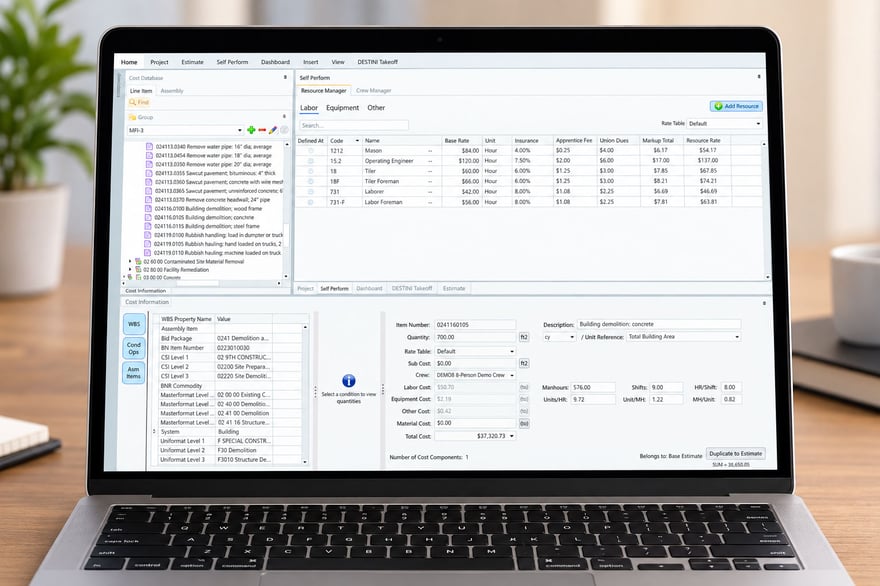
In practice, an estimator can complete 2D and 3D takeoff directly connected to the estimate - with AI-assisted takeoff detecting, measuring, and counting objects on the drawings - then drive self-perform line items straight off those quantities. Build the crew, assign labor by trade and rate, add equipment, set a production rate, and the platform carries the cost through. Historical cost data backs the rates up, so the number is defensible rather than a guess, and live multi-user collaboration means a team can build one estimate together without emailing versions around.
What contractors get out of it
Bringing self-perform estimating into a connected platform changes more than the estimator's afternoon. It changes how defensible the number is, how fast the team can turn it around, and how clearly leadership can see the margin they're carrying:
- Estimates you can defend - every self-perform cost traces back to a quantity, a production rate, and a crew, backed by historical data. When an owner or project executive asks how you got the number, the answer is in the estimate, not in someone's memory.
- Takeoff and estimate that stay in sync - quantities flow from 2D/3D and AI-assisted takeoff straight into line items, so there's no re-keying and no silent drift when drawings are revised.
- Margin you can see - because labor, equipment, and production assumptions are explicit, contractors can see where self-perform margin lives, and stress-test it, instead of discovering it in the field.
- One source of truth, built together - live, multi-user collaboration in the cloud means a preconstruction team builds a single estimate in real time, with no version juggling.
When quantities, crews, and cost data live in one connected platform, contractors can bid their own scopes with the same confidence they'd expect from a subcontractor's proposal - and keep the margin that comes with performing the work themselves.
Learn More About DESTINI Estimator →